



LSU Researchers: Honey Bees Sense Viruses in Food … and Fly Right into the Trap
April 16, 2026
Do Viruses Hack Honey Bee Behavior?
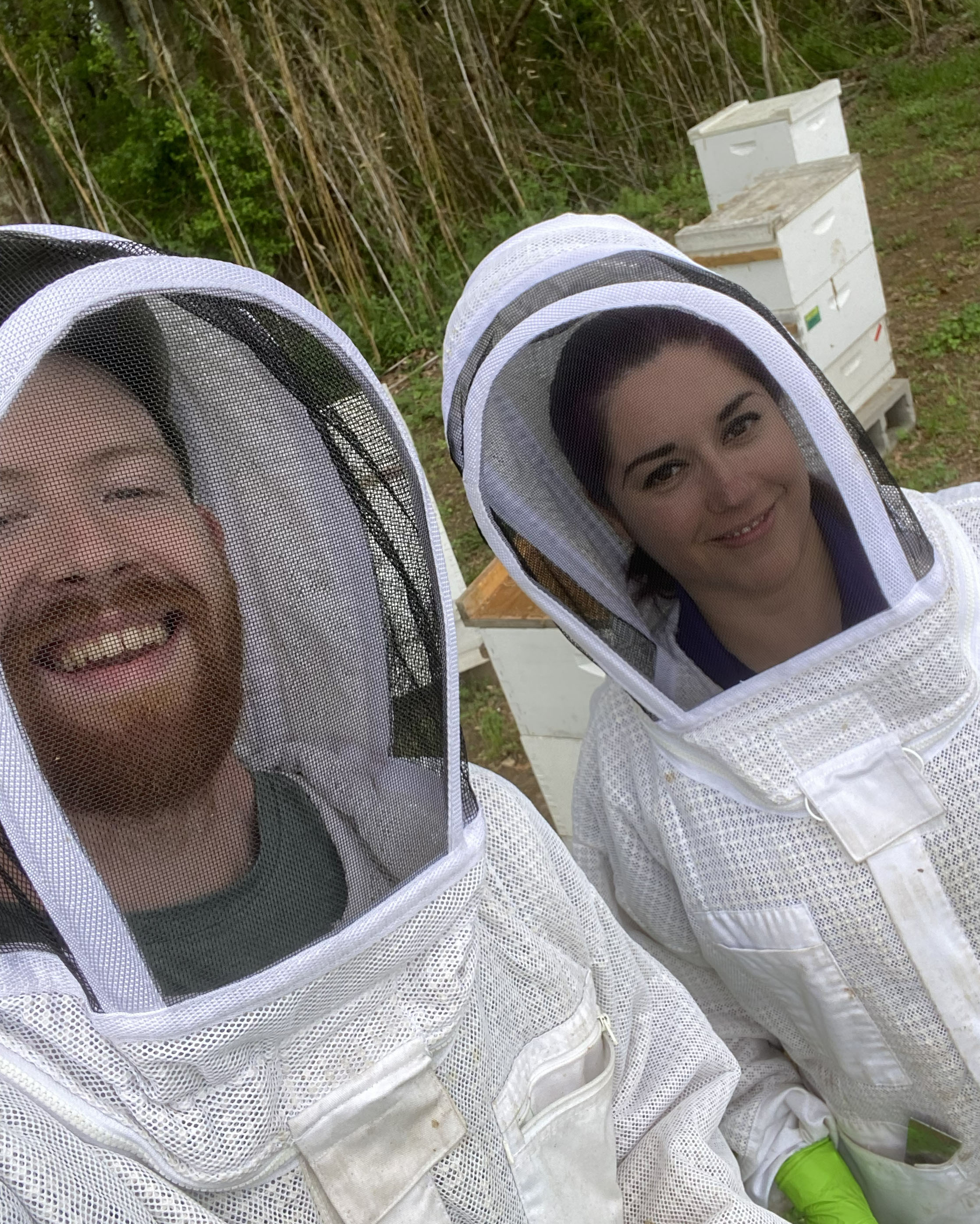
Paula Castillo Bravo, an LSU AgCenter entomology researcher and extension agent, and Joseph McCarthy, an extension associate at the AgCenter, conduct field studies with honey bees.
Many insects can detect and avoid parasites to stay healthy. They can change their behavior in myriad ways to avoid infection.
Leaf-cutter ants shift to foraging at night when a parasitoid fly is around. Some termites groom each other to remove fungal spores from their bodies. And honey bees are known to remove larvae infected with certain bacteria, fungi, and mites from the nest.
Honey bees have sophisticated chemical sensing abilities for this purpose. Researchers in the Netherlands found that honey bees can even be trained to detect animals infected with the virus that causes COVID-19.
Honey bees can clearly sense and identify sick individuals in many cases. What’s not clear, however, is whether they can directly detect and avoid a pathogen, such as a virus, in a food source.
Certain flowers can serve as viral hotspots for diseases such as deformed wing virus (DWV). Can honey bees detect and avoid virus-laden flowers? Researchers from LSU and the USDA Agricultural Research Service tackled just this question in a recently published study.
But they weren’t prepared for the results.

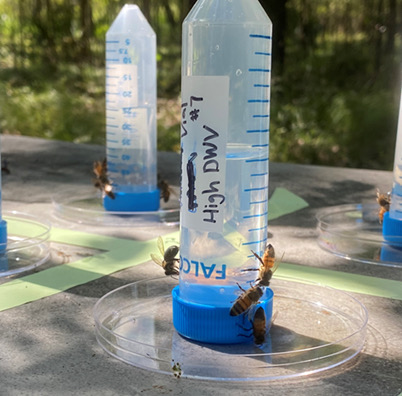
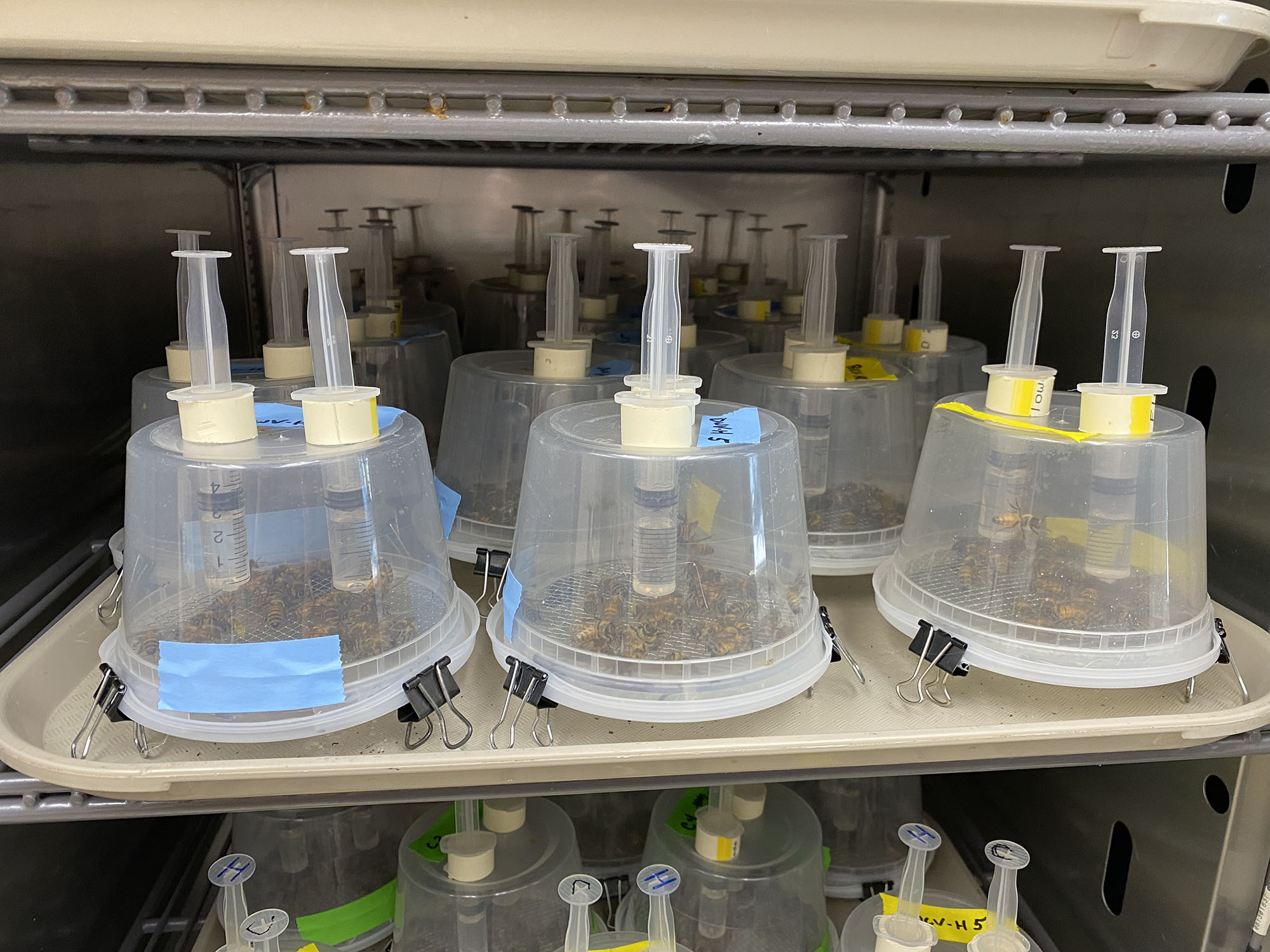
The researchers designed cage trials and field assays to assess conditions under which honey bees will choose a virus-spiked food source over a virus-free one, or vice versa. Above and below left: Feeders are used in a field test to determine bees' preference. Below right: Bees in containers with feeders during a cage test.
It Began as a Science Fair Project
“We were mentoring a student through a simple experiment that was designed to see how the bees would react to viruses in their food,” said Joseph McCarthy, an extension associate in the Entomology Department at the LSU AgCenter. “In that first experiment, we gave bees in a cage two food options: sugar syrup treated with virus, and sugar syrup without any virus.”
The team originally expected the bees to either show no preference or choose the syrup without any virus. But that’s not what happened.
“To our surprise, the bees were feeding from the virus-treated syrup significantly more than the virus-free food,” McCarthy said. The honey bees often opted for the sugar with the hidden viral sting. Viral fragments alone were sufficient to attract bees to the virus-spiked food source.
The results prompted the team to conduct additional experiments at the USDA-ARS Honey Bee Breeding, Genetics & Physiology Laboratory in Baton Rouge, Louisiana. The researchers designed cage trials and field assays to assess conditions under which honey bees will choose a virus-spiked food source over a virus-free one, or vice versa.
A Sticky, Viral Mystery
For cage trials, 40 individual nurse bees (young worker bees) were randomly distributed into plastic cages, each containing two gravity syringe feeders.
In the experimental cages, one feeder contained a simple sugar solution while the other contained a virus-spiked diet made from purified viral extracts of infected bees. The researchers recorded the eating habits and the daily survivorship of the bees in each cage.
At least when tested in the fall season (but not in the summer), the nurse bees appeared to directly detect viruses in their food sources. But instead of avoiding these harmful viruses, they made a beeline for them.
“To our knowledge, this is the first indication that honey bees, or any insect, can directly detect and respond to viruses outside of a host organism.”
Joseph McCarthy, an extension associate in the Entomology Department at the LSU AgCenter
The nurse bees generally consumed more of the diets spiked with deformed wing virus, black queen cell virus, or chronic bee paralysis virus. The researchers ruled out the possibility that other compounds left over from sick bees or pupae, from which viruses were extracted, caused the bees to be attracted to the virus-spiked diet.
“We wanted to evaluate if the bees were attracted to possible proteins present in viral exacts from sick bees; but at the end, we determined that the amount of proteins were very low, near to undetectable levels for the bees,” said Paula Castillo Bravo, an LSU AgCenter entomology researcher and extension agent and study author.
“To our knowledge, this is the first indication that honey bees, or any insect, can directly detect and respond to viruses outside of a host organism,” McCarthy said.
The team then conducted a field assay in Baton Rouge in which they offered foraging bees multiple sugar syrup feeding stations—some spiked with DWV and others free of virus. The bees had been trained for several weeks to forage at the experimental feeding stations, which only contained pure sugar diets before the experiment officially began. But once it did, the results were stark.
“The foraging bees preferred virus-treated food regardless of season,” McCarthy said. More bees visited the feeders containing a high virus treatment than feeders containing a low virus treatment, pure sugar solution, or water only.
Field trial food choice tests comparing visitation and consumption between virus-spiked and virus-free diet treatments.
“It was fun to observe how the bees naturally made their food choices, and it was absolutely surprising when they preferred food with virus on it,” Castillo Bravo said.
What in the Hive Is Going On?
The researchers from LSU and the USDA Agricultural Research Service have some theories, but more research will be necessary to unravel the mystery of these virus-loving honey bees. One theory is that the DWV and other viruses that infect honey bees may be somehow manipulating the bees’ brains and behaviors to consume more virus.
Pathogen mind manipulation isn’t unheard of; there are fungi that can make ants become unwitting living spore factories, and you might have heard of a tiny parasite that can make mice—and perhaps humans—go all heart-eyes-emoji for cats.
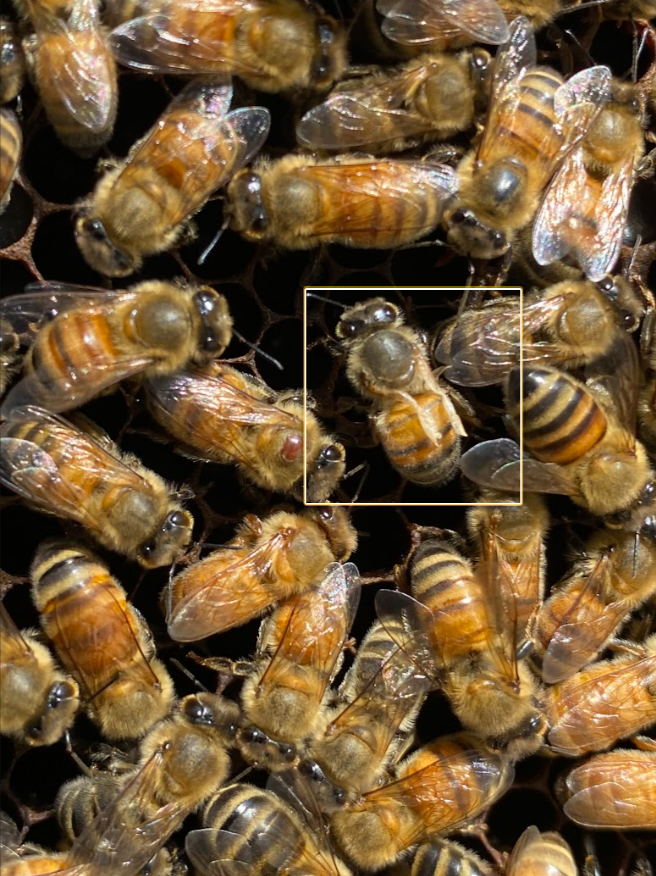
The highlighted honey bee shows symptoms of deformed wing virus.
But the researchers would need to test whether only previously virus-infected honey bees seek out a virus-spiked diet.
Granted, DWV is so widespread currently that most bee colonies are infected. However, dose matters. Viral infection levels being naturally higher in the fall could explain why the caged nurse bees ate more of the virus-spiked food in the fall than in the summer, but further research would be needed to explore this.
“We don’t know exactly the mechanism at work. It may have parallels with ‘zombie’ parasites, but we can’t say that without further experiments,” McCarthy said. “There are examples of other viruses manipulating their hosts in that way, but none in honey bees.”
There’s also the mystery of how the honey bees are even detecting the presence or absence of the viruses in the sugar syrup. Viruses themselves do not produce odorants or metabolites in the way bacteria and fungi do, making it unlikely (but not impossible) that honey bees are detecting these viruses through typical chemosensory pathways.
“There are still a lot of questions that we are excited to investigate,” McCarthy said.
Ultimately, this study advances an understanding of honey bee and virus interactions. It has important implications for bee epidemiology and viral transmission, particularly in light of recent and ongoing honey bee declines as a result of viral infections.
Also, efforts to reveal the mechanisms with which bees are directly sensing viruses could help scientists understand how other biological systems, perhaps even human cells, might be able to harness similar mechanisms to avoid infection.
“We found evidence that honey bees directly detected viruses within contaminated food sources, which in turn influenced their feeding and foraging behaviors,” McCarthy said.
Left to discover is how that detection is happening and why it is driving bees to seek out virus-spiked food sources.
Read the study: Attraction versus avoidance: Honey bees vary in response to virus-contaminated food
Editor's Note: For more in-depth information from the USDA Agricultural Research Service team, see this webinar on the study: Good or Gross?: Honey bee response to viruses in their food