


Geaux Green: LSU's Earth Week Sustainability Efforts Go Far Beyond Campus
April 17, 2026
Earth Day is traditionally a one-day event. At LSU, it has grown into a full Earth Week. The expanded programming goes beyond raising awareness. It also reflects Louisiana’s environment and culture. Students have opportunities to connect with sustainability in ways that feel personal.

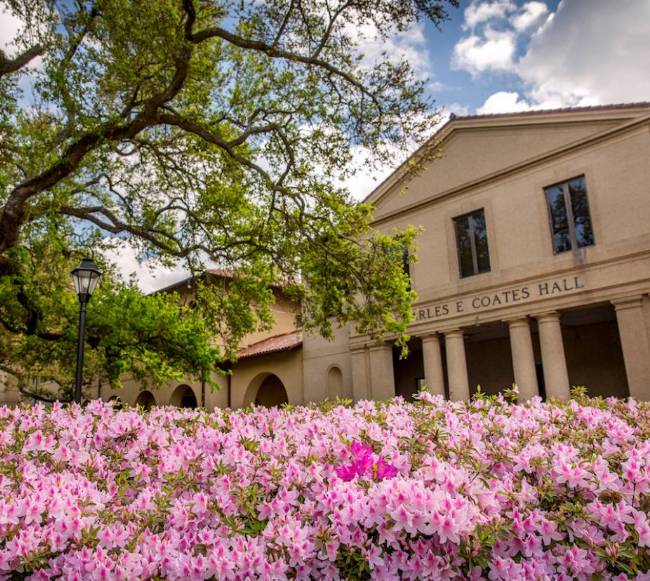
Flowers bloom on the LSU campus with Memorial Tower in the background.
In this Q&A, Lisa Mahoney, assistant director of Campus Sustainability, explains the decision to move toward a week-long format and how hands-on activities from connecting to nature through goat yoga to building Earth-friendly habits by planting nearly 5,000 native and perennial plants at Himes Hall are designed to build long-term habits.
What does Earth Day mean to the LSU community as a whole?
Earth Day at LSU is both a reflection and a responsibility. While Baton Rouge once hosted large-scale Earth Day celebrations, the focus today has shifted toward rebuilding that sense of environmental awareness through campus-driven efforts. As the state’s flagship university, and a central part of the city, LSU strives to be a leader setting an example for how a community should care for its environment. More importantly, Earth Day serves as a reminder that sustainability is essential to the environment.
Why expand Earth Day into a full Earth Week?
The decision to create Earth Week came from a realization that one day isn’t enough. Sustainability is too important to be recognized as a single event. By promoting activities across an entire week, LSU creates multiple opportunities for students to engage. Each event is designed not just to raise awareness, but to reflect Louisiana’s environment and culture. Whether it’s through art, wellness, volunteering, or education, Earth Week allows students to connect with sustainability in ways that feel personal. The variety of events increases the chances that something will “click” for each participant, sparking a mindset that will last beyond college.
What events can students expect during Earth Week?
Earth Week offers something for everyone:
- A no-sew T-shirt workshop in Free Speech Alley promoting reuse – Monday, 4/20 from 12 p.m.-2 p.m.
- Goat yoga for wellness and connection with nature on the Parade Grounds – Tuesday, 4/21 from 5:30 p.m.- 7 p.m.
- Spring Greening Day, where volunteers can plant native greenery to beautify Himes Hall, free lunch and a T-shirt will be provided – Wednesday (Earth Day) 4/22
- Fun environmental trivia, research opportunities, and tools to learn about environmental issues and solutions. A book display, showcasing environmentally significant books to check out is available the entire month of April – Thursday, 4/23 from 11 a.m. - 2 p.m.
- Arbor Day tree planting in the Art Quad – Friday, 4/24 from 11 a.m. - 2 p.m.
- A campus-wide litter cleanup tied to Louisiana’s “Love the Boot” initiative – Saturday, 4/25 from 9 a.m. - 12 p.m.
For more information or to get involved, visit the LSU Earth Week web page. Registration is required for certain events.
Why is hands-on involvement so important in sustainability efforts?
Hands-on involvement can create a deep personal connection that information alone can’t achieve. When students physically participate in activities like planting greenery, sorting recyclables, or cleaning litter, they can really understand the scale and impact of the environmental issues in our community.
LSU’s recycling initiatives allow students to see exactly what happens to materials after they’re discarded. Instead of recycling being an abstract concept, it becomes a visible, interactive process. The goal is for this experience to build awareness and accountability.
At LSU, students aren’t just learning what sustainability is—they’re learning how it fits into their daily lives and how their actions can contribute to larger environmental systems.
How do these events influence students in the long term?
With more than 30,000 students coming from across the country and around the world, LSU becomes a hub for sustainable practices. Students who participate in Earth Week often carry these habits with them after graduation. Whether it’s recycling, reducing waste, or advocating sustainability in their careers, the lessons learned at LSU don’t just stay on campus. One student’s experience during Earth Week has the power to influence an entire community elsewhere, leading to broader mindset changes around sustainability.
How do initiatives like Spring Greening Day create a sense of ownership?
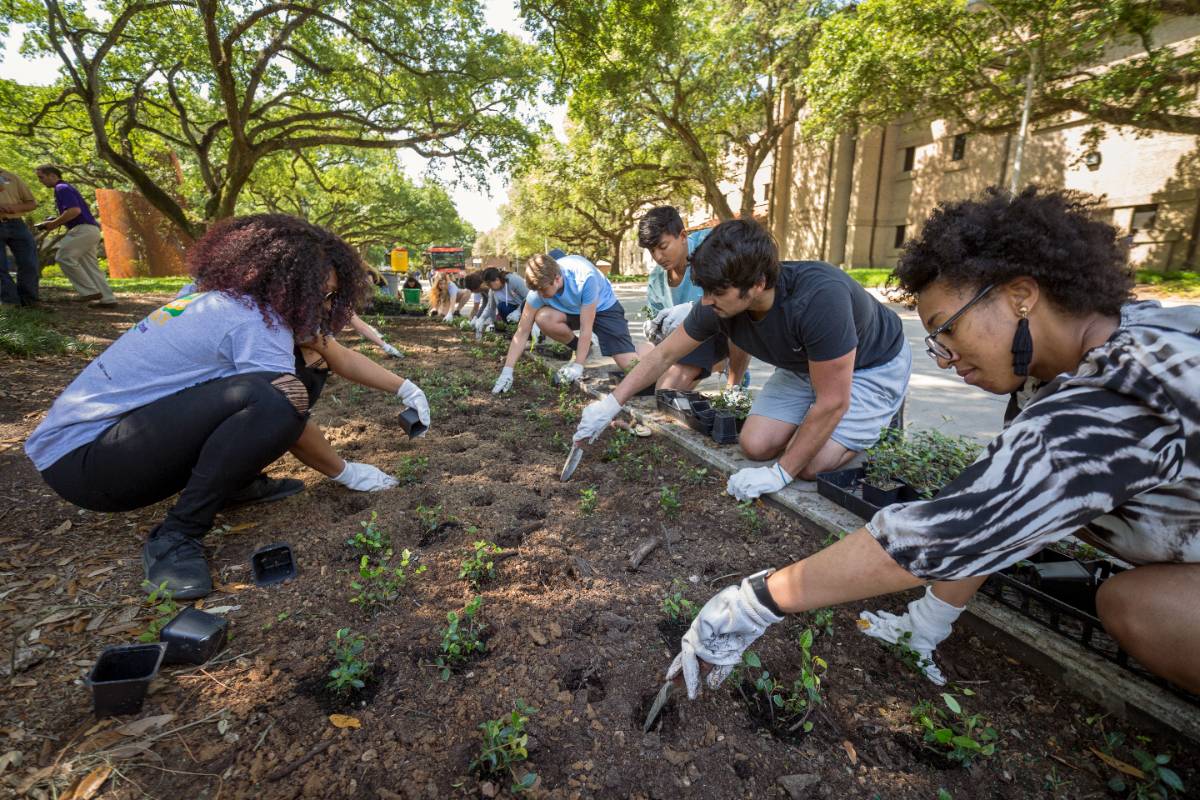
Spring Greening Day is one of LSU's most impactful campus events.
Spring Greening Day, which takes place on Earth Day, April 22nd , is one of LSU’s most impactful events because it allows students to leave a visible legacy on campus. Volunteers help transform a specific area of campus planting greenery, improving landscapes, and creating spaces that future students will use and enjoy. This year volunteers will beautify Himes Hall by planting approximately 4,932 native and perennial plants covering 5,317 square feet in grounds.
Students who participate in Spring Greening Day often feel more connected to campus, knowing they played a role in shaping its appearance fostering a sense of pride and ownership. Participating in Spring Greening Day also has a behavioral impact. Areas on campus that have been beautified tend to experience less litter. People are less likely to damage or neglect spaces that look cared for—and especially those they’ve helped create. This demonstrates how environmental improvements can influence human behavior in positive ways.
What role does collaboration play in these events?
Collaboration plays a critical role in LSU’s sustainability efforts. Earth Week aims to bring together a wide range of groups, including student organizations, academic departments, and community partners. Several groups like the LSU horticulture clubs, engineering organizations, Greek life, and even external volunteers such as Girl Scouts and Southern University all participate in various Earth Week events.
This diversity helps strengthen the initiative by bringing in different perspectives and skill sets. It also reinforces the idea that sustainability isn’t limited to one discipline. Whether a student studies engineering, art, or business, there’s aways a place for them in environmental efforts, building a campus-wide culture of sustainability.
Why should people beyond LSU care about these efforts?
LSU’s role as the state’s flagship university means it has the power to influence more than just its students. The campus serves as a model for greater Baton Rouge and the state of Louisiana.
LSU’s impact goes far beyond campus through initiatives like Keep Louisiana Beautiful, and the annual Gameday Recycling Challenge, connecting student efforts to the greater Baton Rouge community. Through programs like “Love the Boot Week,” LSU organizes litter cleanups that not only improve campus spaces but also contribute to statewide efforts to reduce waste and promote environmental responsibility.
The annual Game Day Recycling Challenge attacks the huge amount of waste generated during football games by increasing access to recycling bins and involving students in the sorting process to win a prize. Not only does this help reduce landfill waste but also helps build a culture where recycling becomes part of the game day tradition. Together, these initiatives show how LSU’s sustainability efforts create real, visible change while setting an example other communities can follow.
What is the biggest takeaway from Earth Week?
The biggest takeaway is that sustainability becomes more meaningful when it’s a personal experience. Earth Week shows students that small actions like recycling, reusing materials, and volunteering can collectively create significant change. It also highlights the importance of consistency.
Advocating sustainability isn’t something that happens one day a year; it’s built through daily habits and ongoing efforts. Earth Week at LSU is ultimately about empowerment. It gives students the tools, experiences, and confidence to take responsibility for the environment not just during college, but throughout their professional careers and personal lives.